
Chichen Itza, Mexico
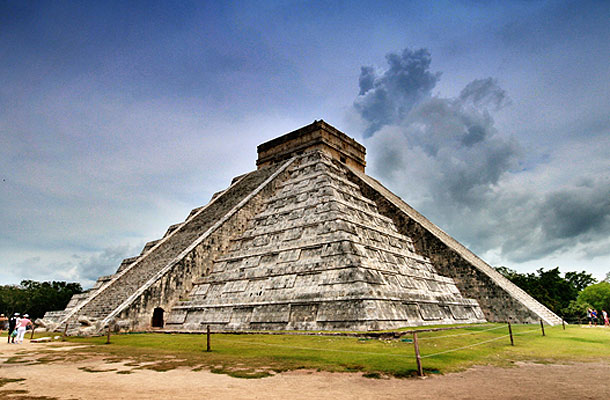
The site became known in 1843, when John Lloyd Stephens visited the Yucatan region,
including several Mayan cities and reported about his travel in the �Incidents of Travel
in Yucatan� book. The Chichen Itza historical site features plenty of beautiful stone buildings
connected through a very developed network of paved roads. The most popular areas are the Great
Ball Court, the Central Group and the Great North Platform, the latter containing probably the
best known monument from the site, the El Castillo (Temple of Kukulkan).
Located in the Yucatan Peninsula in Mexico, Chichen Itza was founded in the 6th century
(around 550 AD) by the Maya civilization, as a ceremonial center. The name is Mayan for �at
the mouth of Itza�s well� and apparently comes from Itza, the name of an ethnic group very
powerful at that time. For three centuries, the civilization and culture around Chichen Itza
flourished, but in the 10th century the city was completely abandoned. There is still no
explanation on why this happened but archaeologists discovered many Mayan cities being abandoned
around this period. Around 1000 AD the Mayans returned to Chichen Itza, but the city started to
decline and never reached its previous power, all ending in the 16th century, when it was conquered
by the Spanish Conquistador Francisco de Montejo and transformed into a cattle farm by the Spanish
government. Today, the Chichen Itza site is visited by more than 1.2 million visitors every year.
Christ the Redeemer, Rio de Janeiro, Brazil
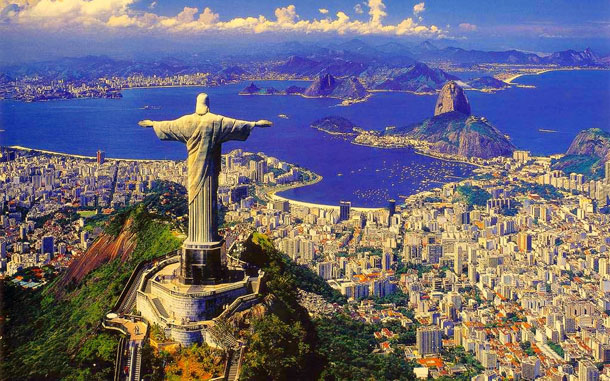
At a height of 130 ft (39.6 meters) and a width of 98 ft (30 meters), Christ the Redeemer
�Cristo Redentor� in Portuguese) is one of the largest Art Deco statues in the world and is
Rio de Janeiro�s iconic landmark. The statue is located in the Tijuca Forest National Park,
on top of 2,300 ft (700 meters) Corcovado mountain, overlooking Rio and depicting Jesus with
its arms stretched (a symbol of peace).
Though around 1850 Princess Isabel dismissed the first project of building a large statue
on the Corcovado mountain the Catholic Circle of Rio didn�t abandon the idea and 70 years
later, in 1922, the construction began. The statue was designed by Brazilian engineer Heitor
da Silva Costa and was executed by French sculptor Paul Landowski, using reinforced concrete
for the core structure and soapstone for the outer layer. The construction was finished in 1931
at an estimated cost of $250,000 (around $3 million today, considering the inflation).
Over the years, the statue faced several problems that required restoration work. First,
in 2008, it was struck by lighting, the local government being forced to replace some parts
of the fingers, head and eyebrows and installing new lightning rods. And in 2010 the statues
was vandalized, graffiti being sprayed on the right arm and head. Beside these, the statues
needs permanent restoration due to exposure to strong winds and rain.
Colosseum, Rome, Italy

The Roman Empire�s greatest architecture and engineering work, the Colosseum�s
construction started between 70 and 72 AD, under the rule of Emperor Vespasian. The arena
was remodeled and restored several times and during the Roman Empire�s existence it was
mainly used for gladiator and animal fights (for example, Dio Cassius reported more than
9,000 animals killed during the inauguration ceremony). After the Roman Empire�s fall, the
Colosseum�s use was changed several times, by the 12th century being a cemetery, after that
used as a castle by the Frangipani family. In 1349, a major earthquake caused the South side
to collapse and no important restoration process has been made since, most of the stone being
used for other buildings in the area.
In modern history, the Colosseum was restored, the arena substructure was excavated and the
largest restoration effort was made between 1993 and 2000, at an estimated cost of $20 million.
Today the Colosseum is probably Rome and Italy�s most famous landmarks, being visited by
millions of tourists every year. An interesting fact about the arena is that it become a
symbol of fight against the capital punishment, several demonstrations being held here, all
culminating with the Italian government�s decision to change the night-time illumination from
white to gold every time someone with the death penalty is being released or commuted.
Great Wall of China

Located in Northern China, the Great Wall measures more than 5,500 miles, of which the
actual wall is around 3,900 miles, the rest being made up of trenches and natural barriers
like rivers and hills. Construction on the wall was started as early as the 5th century BC
as a way of protecting different areas from invasions and raids. Over the years, following
dynasties made changes to the wall, either repairing or expanding it. But the most important
dyansty in the wall�s history was the Ming Dynasty, which, starting with the 16th century,
rebuilt most of the wall using more advanced techniques and materials such as bricks and
stone, most of the parts visible today dating from this period.
Unfortunately, the only sections in good shape are the ones from tourist areas, because
a large part of the wall is in extremely bad shape: due to erosion from sandstorms hundreds
of miles of the wall disappeared or its height was severely reduced from 16 feet to less than
6 feet, while large parts were taken down for the stone or to make room for other buildings.
For many years, the Great Wall of China was considered to be the only man-made structure
visible from space but recent research and reports from astronauts reported that this is
completely false. While advanced cameras are able to photograph it from low Earth orbit, the
human eye can�t see the wall, even from low orbit 7.7 times better than normal visual acuity
being required.
Machu Picchu, Peru

Also called �The Lost City of the Incas�, Machu Picchu is a historical site located
on a mountain above the Urubamba Valley in Peru. Built at an altitude of 7,970 ft (2,430 meters)
is considered one of the most significant cultural site because it was never discovered by
Spanish conquistadors, so it remained almost intact.
According to archaeologists, the settlement was built around 1450, during the reign of Inca
emperor Pachacuti and even though there are theories claiming it was built as a prison or as
an agricultural testing station, most probably it was designed to be a religious site. Founded
at the height of the Inca Empire, Machu Pichu was abandoned in 1572, during the Spanish Conquest,
the cause being unknown, most probably from diseases introduced by foreign travelers before the
conquistadors arrival. The city was discovered in 1911 by Hiram Bingham who was searching for
another Inca settlement, Vilcabamba and was led to Machu Pichu by a local boy. In 1981 Peru declared
the area a �Historical Sanctuary� and in 1983 the site was included on the World Heritage Site list by
UNESCO.
Petra, Jordan

Jordan�s most visited site, Petra (Greek for �rock�) is an ancient settlement in
the Ma�an Governorate famous for being carved directly into rock. Apparently, a sanctuary
existed in the area long before the 16th century BC, but the actual city was founded around
the 6th century BC and became the capital of the Nabataeansa, ancient people from that part
of Asia. Benefiting from an advanced water management system, the city quickly flourished
and became one of the most important trade centers in the area. In 106 AD, Petra became
the capital of the Roman Empire province Arabia Petraea. It was then when the city started
to decline, mostly because Romans reorganized trade routes and Petra lost its importance,
the final kick being the 363 AD earthquake that destroyed a lot of buildings and seriously
damaged the water conduits system.
Petra came back into popular culture after Swiss explorer Johann Ludwig Burckhardt visited
the ruins in 1812. But it was only a century later that proper archaeological work started
on the site, in 1929, with local tourism exploding after the site was featured in the
Steven Spielberg�s 1989 movie �Indiana Jones and the Last Crusade�, after in 1985 it was
declared a World Heritage Site. Today, according to reports, more than 400,000 tourists
visit Petra every year.
Taj Mahal, India

Built between 1632 and 1653, the Taj Mahal is a mausoleum ordered by Mughal
emperor Shah Jahan to commemorate his wife, Mumtaz Mahal, who died giving birth
to their 14th child. Considering this and the reports depicting the emperor�s grief,
the Taj Mahal is often seen as a beautiful symbol of love. After his death, Shah
Jahan was buried here also, next to his wife and the Taj was neglected, the whole
complex being damaged, especially after the British raids during the Indian rebellion
of 1857. However, at the start of the 20th century, British viceroy Lord Curzon
supervised major restoration process which brought back the Taj Mahal glamor.
Today, the complex is stunning, featuring the beautiful mausoleum made of white marble,
reflecting pools, other buildings, magnificent ornamental gardens and attracting between
2 and 4 million visitors every year. Unfortunately, problems showed up in recent years,
due to pollution, acid rain making the Taj Mahal turn yellow, the Indian authorities
taking strict measures trying to stop this.